Missions · Active
Education programSTEM Diversity through CubeSat Technology
A NASA MUREP-funded program building a hands-on CubeSat curriculum at Texas State — six workshops covering satellite systems, experiment design, electronics, programming, and remote sensing, capped by a student-led CubeSat build.
The problem
The space-technology workforce remains narrow in who it draws from. Texas State is a Hispanic-Serving Institution with a large first-generation student population, and the Space Lab is positioned to broaden access to authentic spaceflight training — but training requires curriculum, hardware, and faculty time that don’t exist by default. This program funds the curriculum.
What it does
The program builds a structured workshop sequence at the Space Lab and the Advanced Prototyping Laboratory (APL), targeted at students who’ve historically been underrepresented in aerospace. The format is project-based, hands-on, and runs alongside the lab’s active satellite missions — so students are learning on the same hardware patterns the lab actually flies.
The six workshops
Each is a 3-hour, hands-on session. Together they take a student from no satellite background to having designed, integrated, and tested a working CubeSat subsystem.
- Intro to satellite systems — architecture, subsystems, what each one does and why.
- Experiment design — systems-engineering methodology applied to flight-based scientific studies.
- Space-flight physics — orbital mechanics, the spacecraft’s environment, and what that environment does to the hardware.
- Basics of electronics — components, circuit design, and assembly fundamentals.
- Programming and controllers — C and Python applied to embedded CubeSat hardware and scientific payloads.
- Remote sensing & instrumentation — the sensors and detectors used in space science, plus the data-transfer chain to the ground.
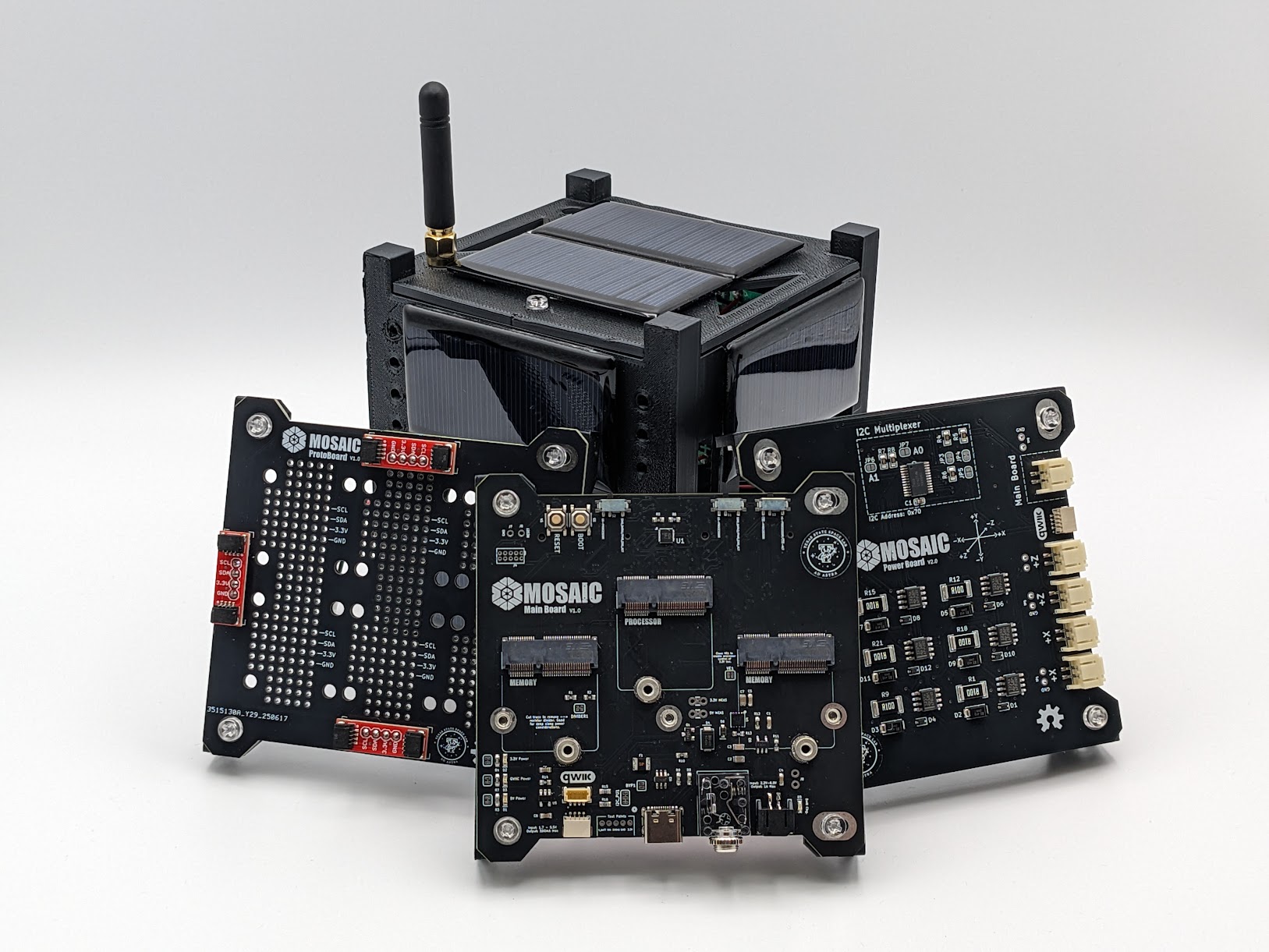
The sequence ends with a practical-application phase where students design, build, and test their own CubeSat projects using the MOSAIC training hardware.
Why MOSAIC
MOSAIC — the Modular Orbital Satellite for Advanced Innovation and Curriculum — is a complete open-source mock CubeSat developed in-house by Evan Jellison as the subject of his M.S. thesis. It lets students customize a flight-representative satellite for a chosen mission without needing a launch slot to learn anything. The workshops use it as the integration substrate for everything taught in the curriculum.
Team and program
Principal Investigator: Dr. Blagoy Rangelov. Co-Investigator: Evan Jellison. The program is funded by NASA’s Minority University Research and Education Project (MUREP), with a performance period of September 2025–September 2026.
Students interested in joining a workshop cohort can read the For Students page or contact the lab.