News ·
PROVES-Maia completes assembly, heads to NASA for vibration testing.
The CubeSat will undergo environmental qualification at NASA Johnson Space Center before being handed off to the launch provider.
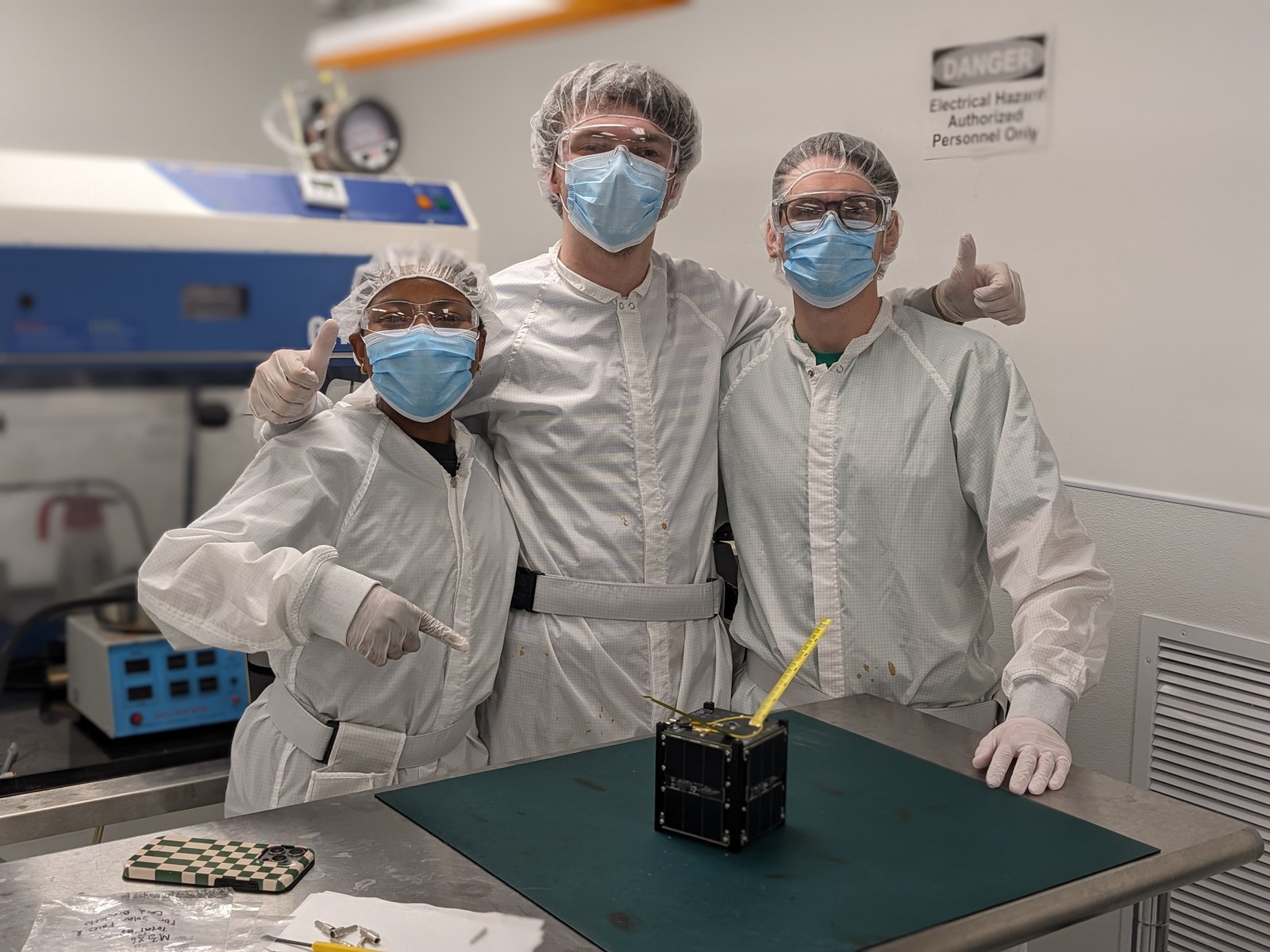
The PROVES-Maia satellite, Texas State University Space Lab’s contribution to the multi-university Pleiades Five Program, has completed assembly in the Texas State clean room and is now preparing for vibration testing at NASA’s Johnson Space Center in Houston.
Final integration was carried out by Space Lab students Jasmine Rawles, Chase Blount, and Johnny McCaskill, who installed the avionics, power, and payload subsystems into the PROVES kit bus over the course of the build phase. The clean-room work brings the satellite to flight-ready hardware configuration.
Vibration testing simulates the mechanical stresses a satellite experiences during launch — high-frequency shaking, sustained acceleration, and acoustic loads from the rocket’s engines. Passing this qualification is a prerequisite for flight. Following testing at Johnson, the satellite will be handed off to the launch provider for integration and flight.
PROVES-Maia is one of the CubeSats in the Pleiades Five Program, a collaboration between Cal Poly Pomona, Columbia University, Northeastern University, UC Santa Cruz, and Texas State. The satellite cluster is manifested for launch through NASA’s CubeSat Launch Initiative.